
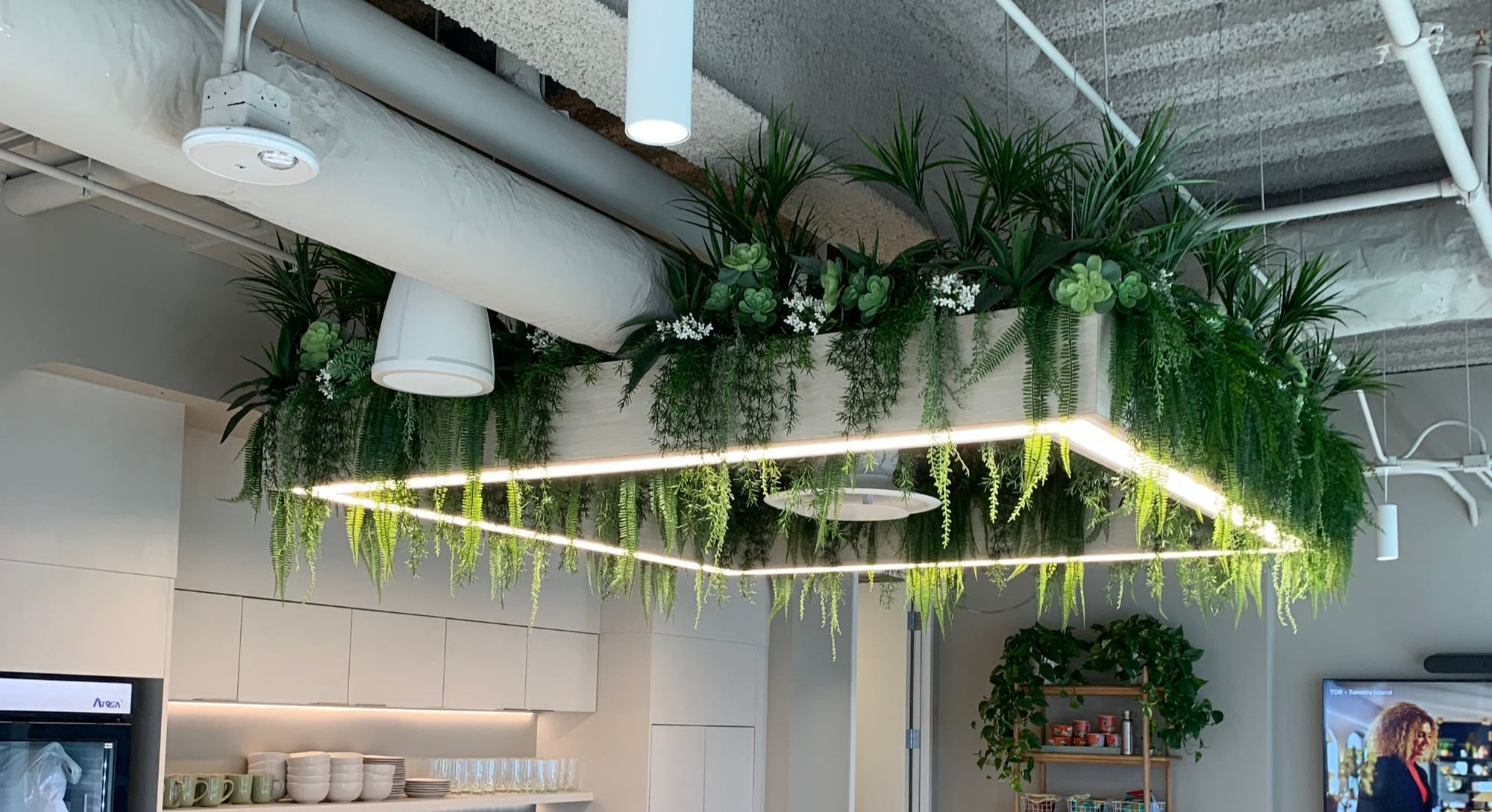
You can usually tell in about a second. Someone walks into a reception area, glances at the planter by the window, and something feels off — even if they could not say what. The shape is right and the green is green, and still the eye refuses to believe it. After 40+ years and 500+ spaces, we find that reaction traces back to a few details you can see once you know where to look.
What gives a bad one away
The first tell is shine. On a poor piece every leaf catches the light the same way, so the whole plant reads as one flat surface instead of many separate leaves.
The second is repetition. Every stem finishes at the same height, one leaf shape appears forty times, and the colour holds a single note top to bottom — often a blue-green no living plant in a Toronto office settles into.
The third is construction. Seams down the middle of a leaf, a base fused to the stems in one piece, wide flat surfaces collecting dust in plain view — each one tells the eye it is looking at an object, not a plant.
A checklist you can use on the spot
Take one plant, stand where your people will stand, and work down this list:
- Do the leaves catch light at different angles, or all at once?
- Do the stems finish at different heights, or level with each other?
- How many distinct leaf shapes can you count?
- Does the colour shift — older growth deeper, newer growth lighter?
- Can you find a seam, a joint or a fused base from two metres away?
- Is there anything behind the front layer, or does it stop at the surface?
If the first three answers come back badly, no planter or placement will rescue that piece.
What good work looks like from across the room
Good pieces vary. Lengths differ, tones differ, and one arrangement carries several leaf forms and several textures — something broad and glossy beside something fine and matte.
Depth is the part most people miss. When taller stems sit behind lower ones and a few trail forward over the rim, the eye travels into the arrangement instead of bouncing off it. That layering is what makes a ceiling planter we built for a Toronto office read as real from across a floor.
The planter matters as much as what goes in it. A good one in the right size does more for believability than a better plant would.
The angles people actually see it from
People see plants from particular angles, and each one asks for something different. A piece on a high ledge is read from below, so its underside has to be as full as the top.
A grouping across an open floor is judged on silhouette and depth, not detail. One in a corridor is seen from thirty centimetres, and that is where seams and finish have to hold up.
Before you buy, ask any supplier, us included, what a piece is certified to and what strong daylight does to its colour. We cover the fire code separately.
Care is light, not absent
Leaves gather dust the way every flat surface in an office does, and dust is what makes good work dull. A light dusting brings the colour and shine back.
We also offer optional refresh visits: our team cleans the foliage and resets anything that has drifted. It is one part of how we design with artificial plants, and it is there if you want it.
Furnishing a Toronto office and want pieces that hold up to a close look? Start with artificial plants in Toronto and tell us what the space needs.
More on artificial plants