
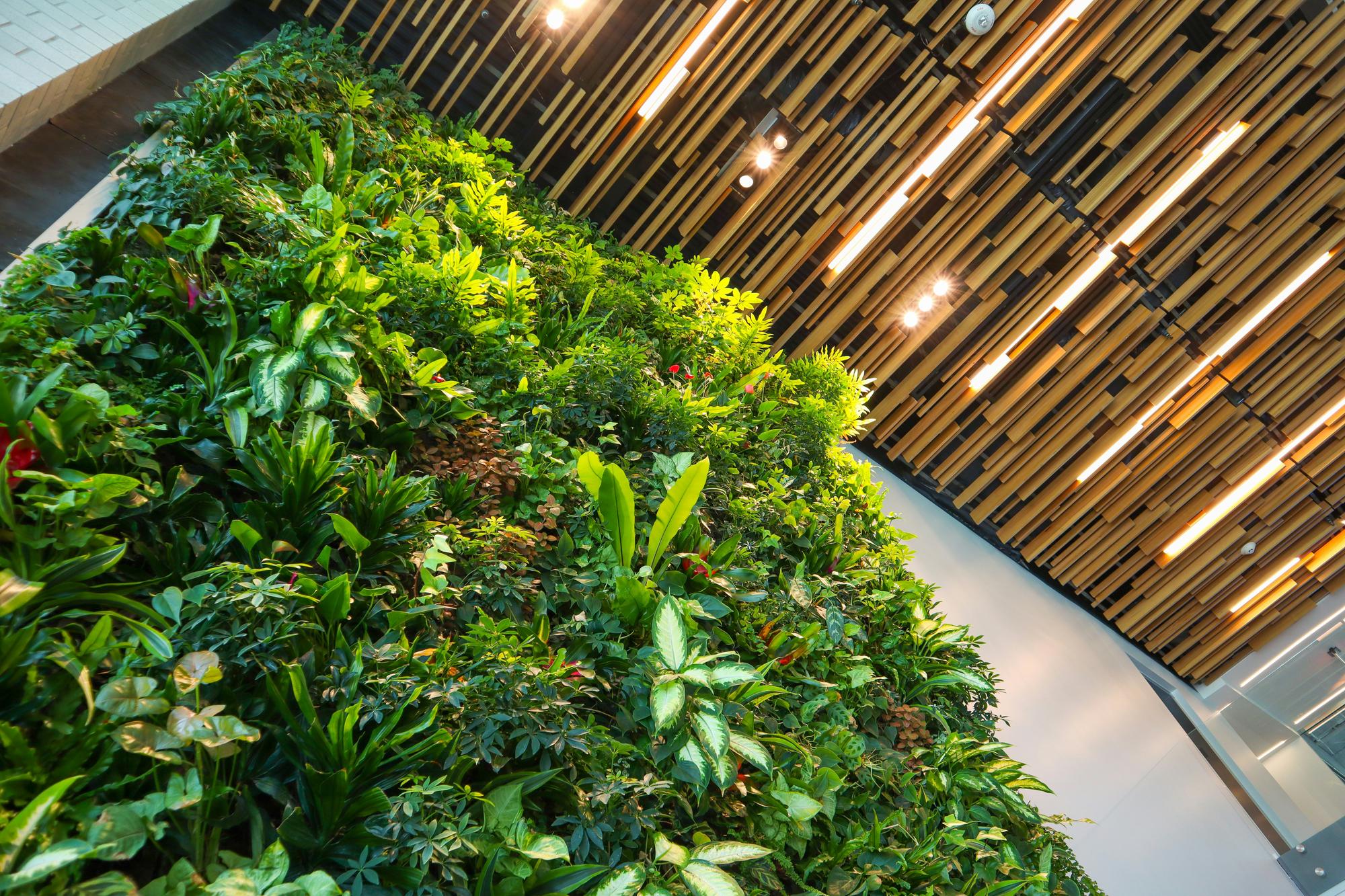
Picture two walls in the same office. One faces a bank of windows in a reception area, where people take a photo before they sit down. The other sits high at the end of an interior corridor, above head height, where nobody lingers. Both could be green walls, and they should not be the same kind.
We build both live walls and artificial walls, and our own team installs them, so we have no reason to push you either way. After 40+ years in Toronto offices, what we keep seeing is that the wall settles the question long before taste comes into it.
A bright office is not a bright wall
The common mistake is judging light by the room instead of the surface. A floor can feel bright while your wall faces away from the windows, sits behind a glass partition, or stands well back from the glass where the light has already fallen away.
Stand at the wall at mid-morning and look at three things:
- Whether daylight lands on the wall's own face, not just in the room
- What sits between the wall and the nearest windows
- How long that light holds through the day
A live wall needs light on its face, day after day. An artificial wall is indifferent to all of this, which is why it works in interior rooms, lower floors and shaded corners.
How high it goes, and whether anyone can reach it
Height changes everything about the years that follow. A wall you can tend from the floor is simple to look after. One that runs up past a stairwell, or starts above millwork, means equipment, closed-off space and an interruption mid-afternoon.
Live walls ask for close, regular access. Artificial walls ask for far less. If reaching your wall is genuinely awkward, that is a real point in favour of artificial, not a consolation prize.
Who will look after it, and how often
Care is always optional with us, never bundled in. So the honest question is not whether a wall can be maintained — it is who will do it, and how often.
Live walls want a set schedule and a trained eye. Artificial walls want occasional refresh visits to keep the foliage clean and the shape full. Both are commitments. Only one of them notices if you skip a month.
What the room is really for
A lobby people photograph rewards a live wall. Up close, real foliage has depth, movement and seasonal change that a camera picks up and a visitor feels.
A corridor is seen at a glance, at walking pace, from a few metres away. An artificial wall does that job beautifully, and asks nothing of the light.
Side by side
| What to weigh | Live wall | Artificial wall |
|---|---|---|
| Light on the wall | Must reach its face | Not a factor |
| Access for upkeep | Close and regular | Occasional |
| Afterwards | Care visits on a schedule | Refresh visits now and then |
| Reads best | Up close | At a glance, and in dim rooms |
| Along window lines | Sun shapes the planting | Ask for UV-protected pieces |
Let the wall decide
The wall usually settles it, and a good supplier says so plainly. Bring us the light, the height, the access and the way the room is used, and the answer tends to arrive on its own.
Walk us through the wall you have in mind and we will tell you plainly which option suits it — see green walls in Toronto.
More on green walls and artificial plants
- How green walls get designed for Toronto offices
- Artificial plants in offices: good versus bad
- Artificial plants and fire code in Toronto
Photo by Elifin Realty on Unsplash