
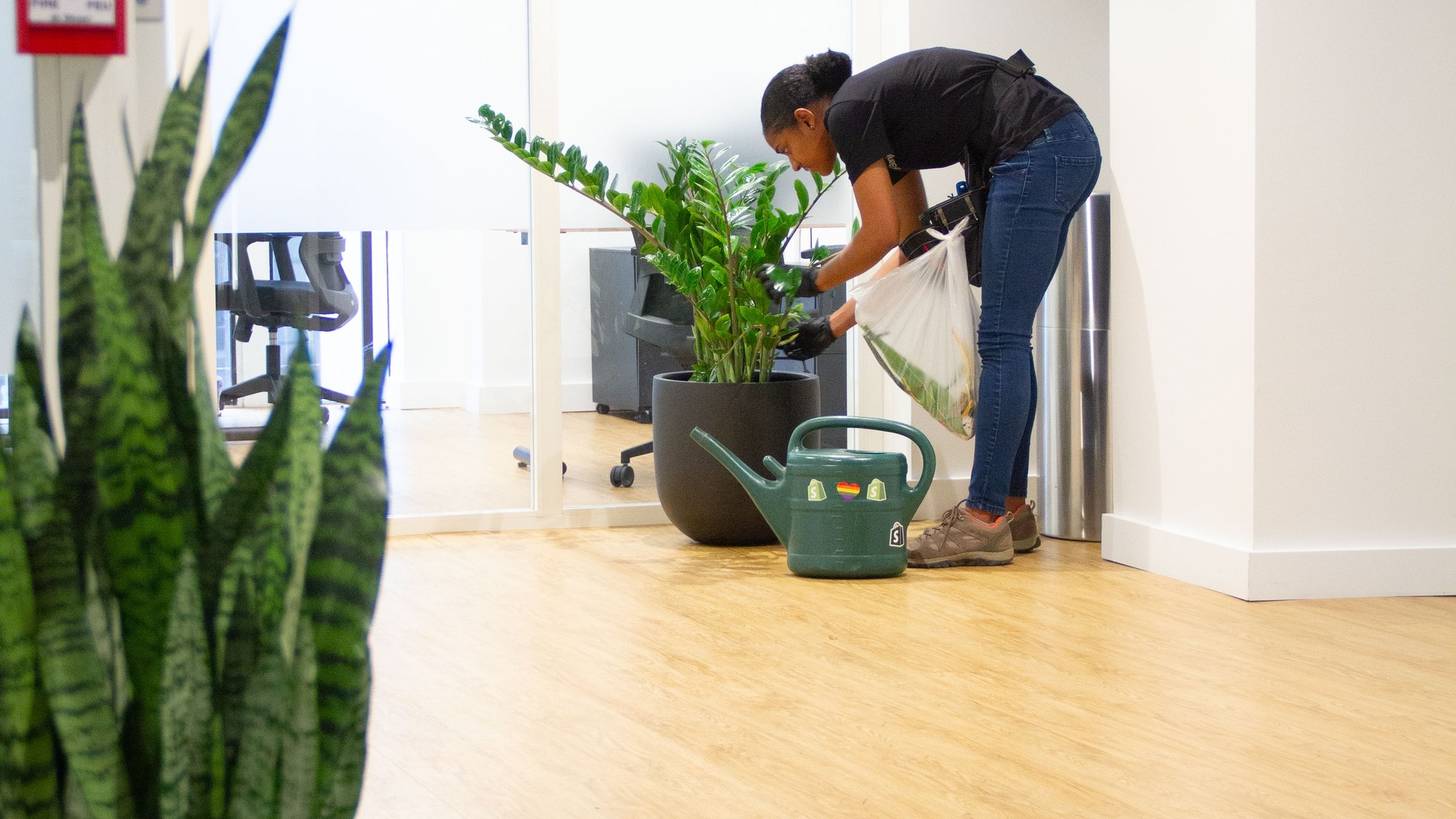
A facility manager in a Bay Street tower called us about a smell. Not a strong one — just a faint sourness near the reception planters that nobody could place. The plants looked healthy. The problem was a few centimetres down, in a mix that had been quietly compacting for two years.
Every office plant sits in something, and that something is a bigger decision than most people realize. It is also the part of the installation nobody revisits.
One disclosure first. Our sister company, Casa Verde Distribution, is an official distributor of LECHUZA planters and PON substrate in Canada, so treat this as an interested party's view. We will be just as specific about what a mineral substrate does not do.
What does indoor plant soil do well?
Organic potting mix is familiar, widely available and forgiving. It holds water and nutrients on its own, so a plant in it can absorb a missed watering without much drama.
That buffer is the whole argument for it. For most desk plants and smaller floor pots, the best soil for indoor plants is simply a good-quality mix that drains well and gets refreshed when it tires.
Where does potting soil fall down in an office?
Soil is organic matter, and organic matter breaks down. A mix slumps, packs down and stops letting air reach the roots — the plant suffocates slowly in a pot that looks perfectly normal from above.
Four things tend to surface in a working office:
- Compaction, which turns a free-draining pot into a sodden one.
- Volume loss as the mix decomposes, leaving the plant sitting low.
- Odour, when a compacted pot keeps getting watered on the old schedule.
- Fungus gnats, which breed happily in damp organic matter.
Media with less organic matter are less attractive to fungus gnats (University of Wisconsin Extension). Less attractive, not gnat-proof — larvae also feed on algae and fungi, so no medium removes the problem on its own.
What is a soilless growing medium?
A soilless growing medium swaps organic matter for inert minerals: usually pumice, lava rock and zeolite in small grains. Growing plants without soil in this sense is not hydroponics — the roots still sit in a solid medium, it simply isn't alive.
Each mineral does one job. Pumice provides drainage and air-filled pore space (University of Arkansas). Zeolite holds nutrients, with a very high cation exchange capacity of 100–200 cmol/kg (University of Arizona Extension). And because there is nothing in it to rot, a mineral substrate does not decompose or shrink the way peat does (USDA-ARS and Oregon State, published in HortTechnology).
What does a mineral substrate ask in return?
Three things, none of them small.
It is heavier. LECHUZA publishes no density figure, but its own shops list a 12 L bag of PON at about 10.8 kg — roughly 0.85 kg per litre, several times the weight of a peat-based mix. For a row of lobby planters, or anything on a raised floor, ask the building before you commit.
It holds no nutrients of its own, so feeding becomes a scheduled task instead of something the medium quietly handles. And it changes how often you water. Our deep dive on LECHUZA PON covers the product itself, and our piece on self-watering planters covers the reservoir side.
So which one should you choose?
A rule that holds up across the spaces we service:
- Stay with soil for small and mid-size plants a technician can reach easily and refresh when the mix tires.
- Move to a mineral substrate for the awkward ones — tall lobby specimens, planters in locked boardrooms, anything where reaching the root zone is a production.
- Confirm floor loading first for anything large, elevated or on a terrace.
- Either way, put feeding and medium replacement on a calendar. Neither option looks after itself.
Most offices end up running both, and that is the right answer rather than a compromise. A mineral substrate for office plants is a maintenance decision more than a horticultural one — which is exactly the call our office plant maintenance service is there to make with you.