
A technician kneels beside a two-metre ficus in a bank lobby, working out why the bottom third of the pot has stayed sodden for weeks. The plant is fine. The soil is not — after two years it has slumped, packed down and stopped letting air through.
That is why mineral substrates exist. Soil eventually stops behaving like soil, a whole floor at a time.
A disclosure before we go further: Casa Verde Distribution, which distributes LECHUZA planters and PON substrate in Canada, is our sister company. Here is what the product actually is, and what it isn't.
What is PON, exactly?
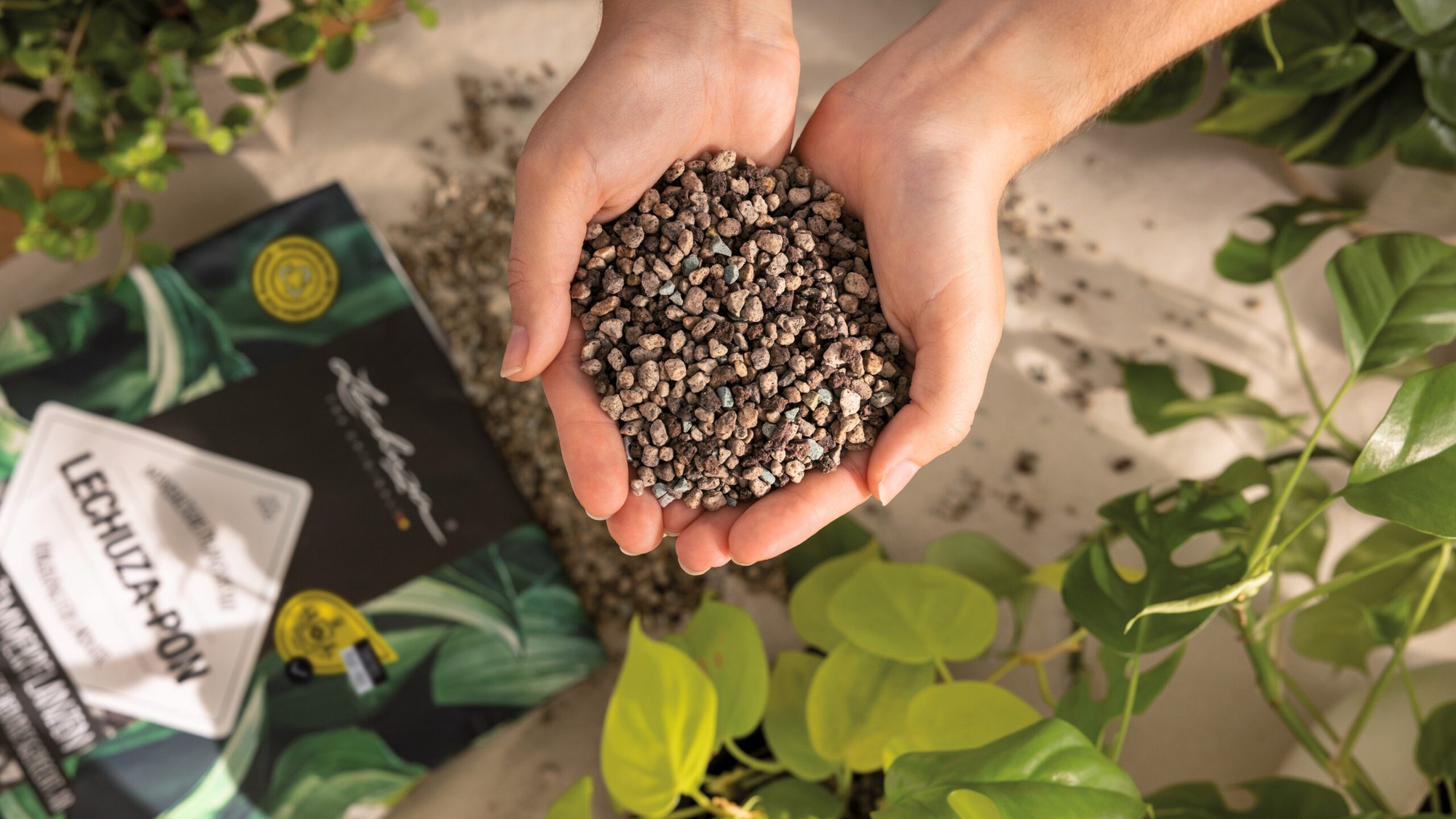
PON is a mineral substrate — small stones instead of soil. LECHUZA's product declaration lists pumice, lava and zeolite, in grains of 2–5 mm.
Each mineral does a job. Pumice gives drainage and air-filled pore space (University of Arkansas). Lava gives structure. Zeolite holds nutrients and hands them back, with a very high cation exchange capacity of 100–200 cmol/kg (University of Arizona Extension).
No peat, bark or compost — so it doesn't decompose or shrink the way peat does (USDA-ARS and Oregon State, in HortTechnology).
How heavy is PON compared with soil?
Nobody online asks this; every facilities manager should. PON is several times heavier than a peat-based mix: peat runs about 0.09–0.16 g/cm³ (University of Arkansas), while a 12-litre bag of PON weighs roughly 10–11 kg, or near 830–950 kg/m³.
For a desk plant that's irrelevant. For a row of lobby planters, or anything on a raised floor or rooftop terrace, check with the building first — and expect a two-person lift.
How do you transition plants to PON?
Here is where most of the internet is wrong. LECHUZA states plainly that "the soil does not need to be removed from the roots when setting the plant into the planter." Washing roots bare stresses the plant and, across a hundred of them, is a lot of labour for nothing.
LECHUZA's guidance:
- Set the plant in with its root ball intact and fill around it with PON.
- Water from the top as usual for the first twelve weeks, while roots grow down.
- Keep as little water as possible in the reservoir meanwhile.
Those twelve weeks are LECHUZA's figure, not a promise from us. One honest exception, from LECHUZA's German FAQ: if the old soil is already infested with fungus gnats, it has to come off completely. PON doesn't cure an infestation.
Does PON need fertilizer after six months?
Yes. PON arrives pre-fertilized, and LECHUZA describes the charge as lasting about six months — "after about half a year, the fertilizer's effect in the substrate begins to wear off." Elsewhere the same company says six to eight months.
The declaration lists a solid inorganic multinutrient fertilizer, NPK 15-11-14+2+ME, in encapsulated pellets, pH 8.2 in water, EC 5 mS/m. LECHUZA also says the substrate keeps a stable pH and releases nutrients as needed, which makes feeding a calendar item rather than a guess.
Can you use PON without a reservoir?
Yes. LECHUZA says all PON substrates "can be used in both planters with an irrigation system and in conventional flowerpots or window boxes."
In a reservoir planter, PON's structure keeps the root zone from turning to mud — our companion piece on what self-watering planters fix and what they don't is worth reading first. In a plain pot it behaves like a coarse, free-draining mix: the top dries quickly and you water more often, not less.
A reservoir still holds a permanently saturated zone at the bottom; no substrate makes overwatering impossible.
Where does PON fit in an office plant program?
It suits the plants hardest to reach by hand: large floor specimens, lobby planters, anything in a locked boardroom or on a high shelf. A mineral substrate for office plants is a maintenance decision more than a horticultural one.
Two limits. Media with less organic matter are less attractive to fungus gnats than peat-heavy mixes (University of Wisconsin Extension) — less attractive, not gnat-proof. And it won't stop surface algae or mould; airborne spores settle on any damp surface.
Sourcing LECHUZA PON in Canada is straightforward; deciding which plants belong in it is the harder part. That's what our office plant maintenance service is for.