
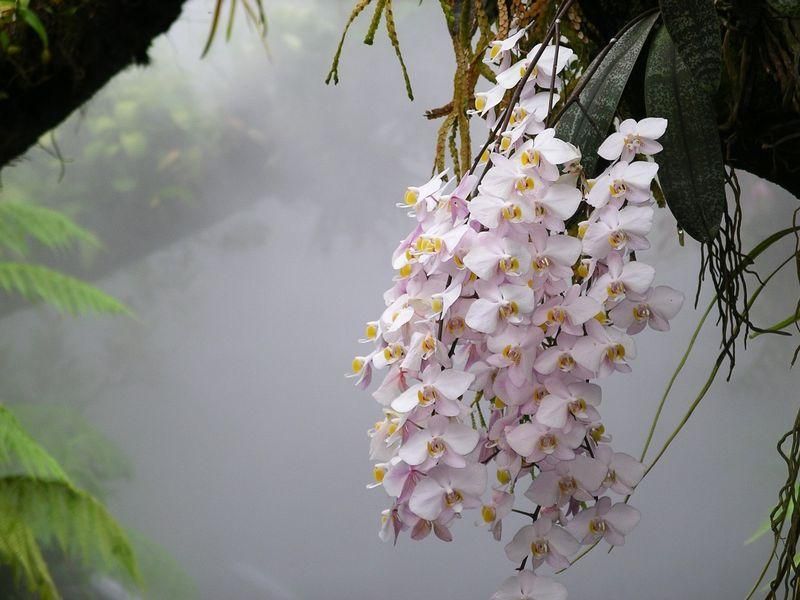
There's a white orchid on the reception desk. Nobody is quite sure whose job it is. Three different people have watered it this week, and one of them used a full mug.
That's how office orchids die. Not from neglect — from enthusiasm.
Three Ice Cubes, Once a Week
Put three ice cubes on the bark, once a week. That's the whole routine.
Three cubes is roughly a quarter cup of water, which happens to be almost exactly what a Phalaenopsis — the standard white moth orchid you see in every reception — wants in seven days.
It sounds like a gimmick. Researchers at Ohio State and the University of Georgia actually tested it against conventional watering over five months and found no difference: same flowering, same bloom life, no damage to the roots.
Why It Works in an Office Specifically
It's a dose, not a judgement call. Nobody has to guess how much. Three is three, and the person covering reception on Thursday can't accidentally give it a mug.
It melts slowly. The bark absorbs it instead of the water rushing straight through and out onto the desk.
It can't overflow. Which matters when the plant is sitting on a counter clients lean on.
One rule: put the cubes on the bark, not touching the leaves, the roots, or the crown.
The Crown Is the Thing That Kills Them
The crown is the point in the centre where the leaves meet. Water that sits there rots the plant from the middle out, and by the time you can see it, it's over.
This is the single most common way an orchid dies indoors — and it's almost always caused by someone pouring water over the top of the plant rather than onto the bark.
Two Minutes of Other Care
Light. Bright, indirect. Near a window is perfect. Direct afternoon sun through glass will scorch the leaves.
Roots tell you the truth. Those thick roots wandering over the edge of the pot are supposed to be there. Silvery-grey means thirsty. Bright green means it just drank. It's the most reliable gauge you have, and you can read it from across the room.
The flowers falling off is not death. Phalaenopsis blooms last two to three months, then drop. The plant is fine. It's resting, and with reasonable light it will send up a new spike.
Don't repot it while it's flowering. Just don't.
If Nobody Is Around
Over a long weekend or the holiday shutdown, an orchid is far more forgiving than most office plants. Skipping a week does no harm at all — it's a plant that grows on the side of a tree in the wild, drying out between rains.
If you're going to be wrong, be wrong in the direction of too little.
The Short Version
- Three ice cubes, on the bark, once a week.
- Never let water sit in the crown.
- Bright indirect light.
- Silvery roots means water. Green roots means wait.
- When the flowers drop, it isn't dead.
Or Let Us Look After It
A white orchid comes with our Complete interior holiday package, and orchids show up in a lot of the Toronto receptions we maintain year-round.
If Benji's already looks after your office plants, orchids are included on our regular visits — no ice cubes required from anyone on your team. If we don't, that's what plant maintenance is.
Related reading
- Poinsettia care: the four things that actually kill them
- The best low-light plants for office spaces
- 7 office decorating ideas that survive a real workday
- What holiday decorating should cost in Toronto
Photo: Phalaenopsis philippinensis in Singapore Botanic Gardens via Wikimedia Commons, uploaded by Javier martin, under CC BY-SA 3.0 — no photographer is named on the file page.
