
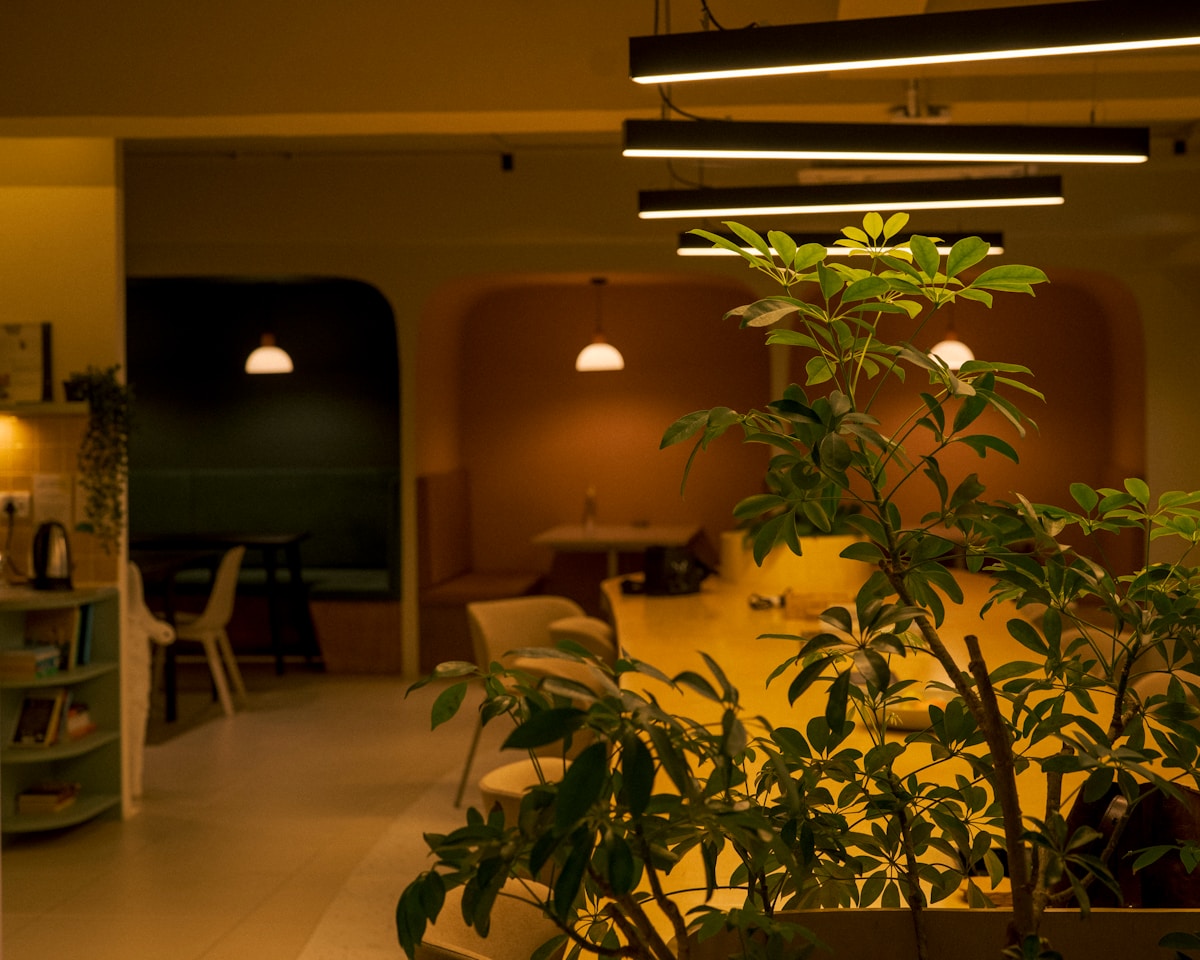
Open-plan offices are the default layout for Finance, Legal, and Tech firms in Toronto. They encourage collaboration — but they also carry sound. Keyboard clicks, phone calls, and ambient conversation travel across the floor and chip away at concentration.
Acoustic panels and white noise systems are the usual fixes. But Toronto facility and HR managers are increasingly adding a third element: strategically placed indoor plants.
Here is what you need to know before adding greenery to your acoustic strategy.
Why Plants Absorb Sound
Plants reduce noise through two mechanisms. Leaves and stems deflect sound waves, preventing them from bouncing off hard surfaces like glass, concrete, and drywall. Soil and dense growing media absorb lower-frequency vibrations. Together, these effects diffuse ambient noise — reducing perceived loudness without the deadening quality of thick acoustic foam panels.
The impact scales with plant mass. A single statement plant does almost nothing. A dense, distributed installation across a floor can measurably reduce reverberation.
Which Plants Work Best
Fiddle-leaf figs (Ficus lyrata): Large, broad leaves deflect sound effectively. A pair of mature specimens flanking a meeting room entrance creates a useful natural buffer.
Peace lilies (Spathiphyllum wallisii): Dense foliage and heavy soil mixes absorb low-frequency hum. They also tolerate the lower light levels typical of interior office positions. Maintenance level: Low to moderate.
Rubber plants (Ficus elastica): Thick, waxy leaves deflect sound waves reliably. Maintenance level: Low. Well-suited for finance floors where water near equipment is a concern.
Pothos (Epipremnum aureum): Cascading vines placed on shelving or partition tops create multi-level diffusion — sound hits foliage at different heights instead of ricocheting off a flat wall.
Boston ferns (Nephrolepis exaltata): Feathery fronds are particularly effective at absorbing higher-frequency sounds, including the frequencies of human speech. Maintenance level: Moderate — they need consistent humidity and regular watering.
Placement Principles
The goal is mass and distribution, not decoration. Effective placement looks like:
- Row dividers: Floor-standing plants placed between workstation rows — fiddle-leaf figs or rubber plants — break the unobstructed sound path across the floor.
- Perimeter shelving: Trailing pothos or philodendrons on wall-mounted shelves add vertical diffusion without using floor space.
- Meeting room thresholds: Dense planters at open entry points reduce sound bleed between meeting areas and the general floor.
- Corner clusters: Sound waves bounce off corners in unpredictable directions. A cluster of mixed-size plants catches and diffuses those reflections.
The Maintenance Reality
The acoustic benefit depends entirely on healthy, dense foliage. A plant that has dropped half its leaves from overwatering, pest damage, or neglect does not absorb sound — and declining plants visible to clients and staff signal something worse than noise.
Benji's has maintained commercial plant installations in Toronto offices for over 40 years. Our team visits on a set schedule to prune for density, replace plants before decline becomes visible, and manage soil health year-round. Your acoustic investment does not degrade quietly — your plants do, unless someone is actively preventing it.
Is This Right for Your Office?
Plants are not a replacement for proper acoustic design. But they are a practical, aesthetically positive complement — particularly in glass-heavy, hard-surface offices where reverberation is worst, and where biophilic design already makes sense for staff wellbeing.
If you want a professional assessment of what plant installations could realistically contribute to your workspace, Benji's offers complimentary consultations for Toronto commercial spaces.
Get in touch with Benji's team.
Photo by Nimal Mathew on Unsplash