
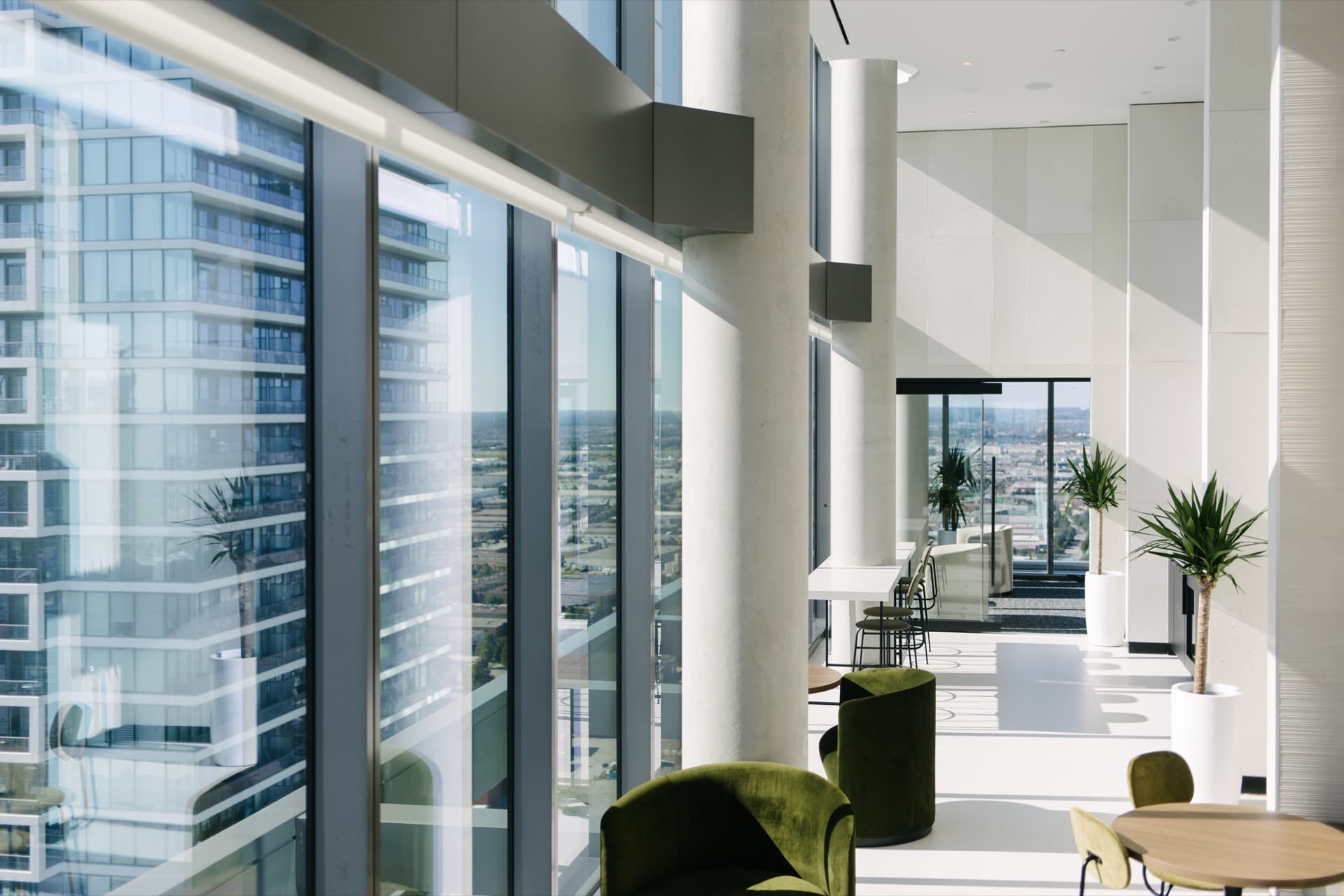
Biophilic Design for Toronto Offices
Toronto's specialist in biophilic workplace design — where people genuinely thrive.
What Is Biophilic Design?
Biophilic design is the practice of incorporating natural elements into the built environment to strengthen the connection between people and nature. The term draws from biophilia — a concept popularised by biologist Edward O. Wilson in his 1984 book of the same name. Wilson argued that humans possess an innate affinity for living systems and the natural world, shaped by millions of years of evolution in natural environments. Strip that connection away, as modern offices so often do, and human health and performance measurably suffer.
Applied to architecture and interior design, biophilia moves beyond simply placing a few plants on desks. It is a comprehensive framework for designing spaces that engage our senses, reduce physiological stress, and restore cognitive resources. This includes direct elements — living plants, water features, natural light, fresh air — as well as indirect ones: natural materials like wood and stone, organic shapes, nature-inspired patterns, and views that evoke landscape depth.
In the context of the modern office, biophilic design has become one of the most evidence-backed strategies for improving employee wellbeing, productivity, and retention. As workplaces compete to attract talent in a hybrid world, the quality of the physical environment has never mattered more. Biophilic design is how forward-thinking Toronto companies are rising to that challenge.
The Research
Proven Benefits for Your Workplace
+15%
Productivity Increase
University of Exeter, 2014
Offices with plants show a measurable boost in cognitive performance and task completion rates.
6%
Reduction in Absenteeism
Human Spaces Global Report
Employees in nature-rich environments take fewer sick days and report higher job satisfaction.
3 VOCs
Removed From Air
NASA Clean Air Study
Plants actively filter formaldehyde, benzene, and trichloroethylene — common office air pollutants.
↓ Cortisol
Stress Reduction
Multiple peer-reviewed studies
Measurable drops in cortisol levels in plant-rich spaces, reducing stress and improving focus.
+19%
Creative Performance
Research in Environmental Psychology
Exposure to natural elements improves divergent thinking — the cognitive mode behind creative problem-solving.
The Framework
14 Patterns of Biophilic Design
Consulting firm Terrapin Bright Green identified 14 scientifically grounded patterns of biophilic design in their landmark report 14 Patterns of Biophilic Design. Below are the patterns most relevant to office environments — and the ones Benji's specialises in delivering.
Visual Connection with Nature
A view of or contact with living plants, water, or natural landscapes. In offices, this means placing greenery in sightlines from desks and throughout common areas.
Non-Visual Connection with Nature
Auditory, haptic, olfactory, or gustatory stimuli that bring nature indoors — from the subtle fragrance of flowering plants to the tactile feel of natural materials.
Thermal & Airflow Variability
Subtle changes in air temperature and movement that mimic the gentle variability of natural environments, reducing the sensory monotony of sealed HVAC systems.
Dynamic & Diffuse Light
Light that changes over time and space — mimicking natural daylight cycles. Plants near windows amplify the play of light and shadow throughout the day.
Biomorphic Forms & Patterns
Shapes and patterns found in nature — spirals, branching structures, leaf forms — integrated into furnishings, partitions, and architectural elements.
Material Connection with Nature
The use of natural materials — wood, stone, cork, linen — that retain or reference their origins in the natural world, grounding the space in organic texture.
Complexity & Order
Rich, information-dense environments that follow natural hierarchies — like a living wall where thousands of leaves create a structured yet intricate composition.
Prospect & Refuge
Spaces that balance openness (prospect) with sheltered enclosure (refuge), mirroring the environments humans evolved in and creating psychological safety.
Our Approach
How Benji's Brings Biophilic Design to Life
Theory is only useful if it can be implemented. Benji's translates biophilic principles into practical, maintained plant installations that transform Toronto offices — without adding a single task to your team's plate.
Visual Connection with Nature
Interior Plant Design
Custom plant plans that place living greenery where it matters most — in sightlines, at entrances, and throughout your workspace.
Learn more
Complexity & Order · Biomorphic Forms
Living Walls
Live or artificial green walls that turn a blank wall into a focal point, bringing several biophilic patterns into a single installation.
Learn more
Non-Visual Connection · Clean Air
Air Purification Plants
Strategic placement of scientifically proven air-purifying species to measurably improve indoor air quality throughout your office.
Learn more
Dynamic & Diffuse · Temporal Change
Seasonal Programs
Rotating seasonal plant collections that shift with the calendar, bringing natural rhythms and visual variety into your workspace year-round.
Learn more
Why Toronto Offices Need Biophilic Design
Toronto winters last five months or more. From November through March, outdoor greenery disappears almost entirely — and for office workers spending eight or more hours a day inside glass towers, meaningful contact with nature can become essentially zero. The psychological toll is real: seasonal affective disorder, low energy, and reduced motivation are common, and they directly impact performance. Biophilic design is one of the most effective ways to counteract that seasonal deficit.
Toronto's office culture is increasingly high-rise. The CN Tower corridor, King West, Midtown, and the Financial District are dominated by tower floors with limited natural light and no meaningful outdoor access during the working day. These environments — by their very architecture — sever the human-nature connection that biophilic design is designed to restore. Interior planting is not decorative in this context; it is remedial.
Post-pandemic, Toronto employers face a new challenge: making the office worth the commute. Hybrid workers have options, and they exercise them. The offices that win the attendance battle are those that offer something a home setup cannot — a thoughtfully designed, energising environment. Biophilic design is central to that offer, and it is why Benji's has seen consistent growth from Toronto's most forward-thinking employers. A city with a growing sustainability culture expects its workplaces to reflect those values — and plants are the most visible, immediate way to show that.
Start Here
Plants We Recommend for Biophilic Offices
These four species are foundational to biophilic office design — proven performers in low-light commercial environments with strong air-purifying properties and high visual impact.
Sansevieria
Sansevieria trifasciata (Dracaena trifasciata)
Snake plants excel in offices because they tolerate fluorescent lighting, irregular watering, and air-conditioned environments. They're one of the few plants that release oxygen at night, making them ideal for enclosed meeting rooms and 24/7 workspaces.
View care guide
Pothos
Epipremnum aureum
In office environments, pothos can be placed on high shelves or in hanging planters to cascade elegantly over workstations and partitions — a living screen that softens the hard geometry of open-plan offices. It adapts easily to the low light and dry air of most commercial spaces.
View care guide
Spathiphyllum
Spathiphyllum wallisii
Peace lilies are an excellent choice for offices that want the warmth and softness of a flowering plant without the bright-light requirements of most blooms. Their white flowers and lush foliage signal care and welcome — ideal for reception areas, staff lounges, and client meeting rooms. They also dramatically improve air quality in sealed office environments.
View care guide
Ready to bring biophilic design to your office?
Book a free consultation. Our team will assess your space and create a biophilic design plan tailored to your environment, budget, and goals.